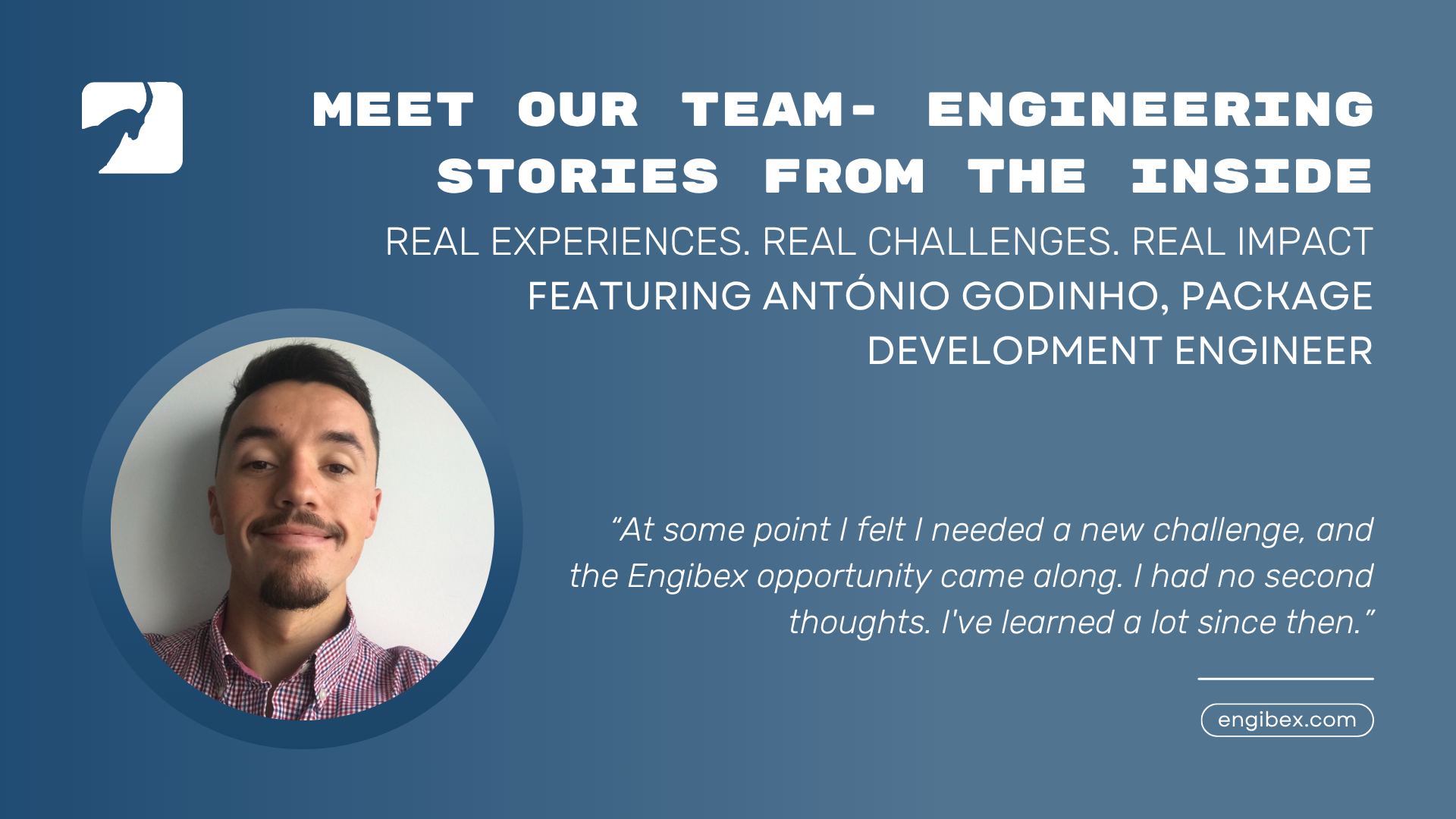
MEET OUR TEAM- ENGINEERING STORIES FROM THE INSIDE. FEATURING Antonio Godinho, Package Development Engineer
In this edition of "Meet Our Team", we speak with António Godinho, Package Development Engineer at Engibex. Originally from Portugal, António has built his career across three countries — from research in Norway to the semiconductor industry in Portugal, and now to cutting-edge IC packaging work in Belgium. With a passion for precision, a love of sport, and a deep curiosity about the future of medical technology, he shares his journey, his engineering mindset, and what keeps him pushing forward.
"You started your career in Portugal, did a research internship in Norway, and are now working in Belgium — what has that international path taught you about yourself as an engineer?"
I started in Portugal, studying electronics engineering. During my Master's, I had the opportunity to join a research group for an international internship — my first real experience abroad. It was a personal challenge from the start. I learned a great deal about working as part of a team, but also about working independently: being able to search for answers and solve problems on my own.
Working with people of different nationalities is interesting, but it's not always easy. I had to adapt to different ways of working, and that adaptation was genuinely useful. When I came back to Portugal after my Master's, I joined a company as an intern. It was different from what I was used to, and once again I had to readapt myself. That's where I entered the semiconductor industry, and it's where I really began to develop as an engineer.
At some point I felt I needed a new challenge, and the Engibex opportunity came along. I had no second thoughts. I've learned a lot since then. The weather here is tough — my previous workplace was right by the ocean — but I'm getting more used to it!
You went from IC Package Development Trainee to IC Package Design Engineer at the same company — what changed in how you think and work between those two roles?
As a trainee, I had much more supervision from senior colleagues. I came in with a background in semiconductor research — more on the electronics and microchip side — so in packaging I was essentially starting from almost zero. I learned how to perform all the tasks step by step.
When I transitioned to an engineer position, the responsibilities grew. I still had guidance, of course, but I was expected to take more ownership. I needed to know which team to contact, who to go to for what — that kind of organisational awareness that comes with experience.
IC packaging is a very niche and specialised field. How did you first discover it, and what keeps you passionate about it?
When I was working with electronics related to microchips, I started wondering: how does this tiny microchip actually end up in a car or a server? I realised it needs to be adapted before it can connect to anything in the real world — it has to be scaled up, packaged, made functional at a larger level.
What I also love about the field is that every chip is different. Different characteristics, different signals to be careful about, a lot of interaction with customers. There's always a lot of knowledge to apply. And the best part is when a project goes well — receiving direct feedback from customers at the end is something I find really rewarding. It helps you grow.
You describe yourself as open-minded and a team worker — can you give an example of a moment where those qualities made a real difference on a project?
For me, open-mindedness means not letting yourself be guided 100% by others, but genuinely understanding how they work and slightly adapting yourself to meet them. It means sharing your opinion, listening to others, and reaching an agreement together — while also knowing when someone else's guidance is more important, and being at peace with that.
There was one project where things weren't going well. Certain aspects weren't working as expected, we were delayed, and there were technical issues in the background. After discussing it with a colleague, they suggested a different path forward. It took about a week of discussion to decide, but we found a middle ground — and in the end, the project went really well. I was also fortunate that most of my colleagues have been open-minded too, and genuinely listened to my input.
Engineering can be tough — long debugging sessions, tight deadlines, complex problems. What keeps you going on the hard days?
When things aren't going well, I try to remind myself that it's just a phase. The life of an engineer is full of ups and downs — if today is a bad day, tomorrow will be better. Sometimes it's simply time to take a break.
In package design, we often work on multiple projects simultaneously, which actually helps. I switch between projects to disconnect a little, and when I come back to the original problem, I often find a different solution. A change of perspective makes a real difference.
You surf, play padel, tennis, football — you're clearly someone who likes to be active and push limits. Does that competitive side show up in your engineering work too?
Definitely. I genuinely cannot live without sport. It's hard to surf in Belgium, but whenever I'm back in Portugal I go surfing after work — it completely clears my head and helps me forget about work. It's a great reset, and the next day you're ready to go again. Here in Belgium I play football and go to the gym to keep that balance.
If you had to describe your engineering style in three words — what would they be, and would your colleagues agree?
Positive, persistent, and friendly. I'd like to think I'm easy to talk to — someone colleagues can approach without hesitation. I believe those qualities matter just as much as technical skills in a collaborative environment.
What made you take the step to move into this new opportunity at this point in your career?
At a certain point, I felt my career path was going straight rather than upward in terms of learning. The Engibex opportunity came at exactly the right moment — it was related to what I was already doing, but went a level deeper, which meant I had a lot of new things to learn in order to perform well.
I also like to stay close to what's new and trending in packaging technology, and this role allows me to chase those new developments. The learning curve here has been incredible.
Where do you see yourself in 5 years — more on the technical specialist path, or growing into a broader role?
I see myself firmly in the technical world for the next five years. I still have a great deal to learn, and to reach the level of team leader I need to develop further — both technically and personally. I also believe that not everyone is meant to be a manager; some people are simply better suited to deep technical work, and there's nothing wrong with that.
Maybe in five years my goals will look different, but for now, this is the direction that feels right for me.
If you could work on any engineering challenge in the world right now, with no constraints, what would it be?
It would still be related to semiconductors — but specifically microchips applied to medical systems. I'm fascinated by the idea of chips that support pacemakers or other devices that function inside the human body. Whenever I work on medical projects, I find myself thinking about how these tiny components interact with human biology.
For me, medical devices are the most meaningful application of what we do. They sit at the intersection of semiconductor engineering and real human impact — and that's where I'd want to be.