
Gear Whine in Electrified Gearboxes: Noise Detection and Optimization
A New Acoustic Challenge for Electric Mobility
The automotive industry is undergoing a profound transformation. Driven by sustainability targets, regulatory requirements, and technological advancements, electrification is rapidly becoming the dominant direction for future mobility. While electric and hybrid powertrains offer significant benefits in terms of efficiency, emissions reduction, and vehicle performance, they also introduce a new set of engineering challenges that extend beyond battery technology and power electronics.
One of these challenges lies in the field of Noise, Vibration and Harshness (NVH). Today gearbox NVH, particularly in electric and hybrid vehicles, has become a key contributor to the overall vehicle quality and customer perception.
The reason is simple: electric powertrains are quieter than internal combustion engines. As traditional masking sources disappear, occupants become increasingly sensitive to drivetrain-related noise. Gear whine, bearing noise and other tonal phenomena that were once hidden behind engine combustion noise are now clearly audible. Consequently, transmission manufacturers and vehicle OEMs face growing pressure to deliver drivetrains that are not only efficient and durable but also acoustically refined.
Noise Perception: How Sound Waves are Interpreted by Humans
Sound is a mechanical wave that propagates through a medium as fluctuations in pressure. While sound can be described objectively by measurable quantities such as sound pressure level or frequency, noise is inherently subjective and is generally defined as unwanted or undesirable sound. Consequently, the perception of noise depends not only on its physical properties but also on the characteristics of the listener, the surrounding environment, and the context in which it is experienced.
The human hear can respond to sounds ranging in intensity from 0 dB to 140 dB, in a range of sound pressure measured in logarithmic decibel scale, while the range of human hearing is usually stated from 20 to 20000 Hz. [1]
However, the human ear is not equally sensitive across this frequency range, as can be seen in figure 1.
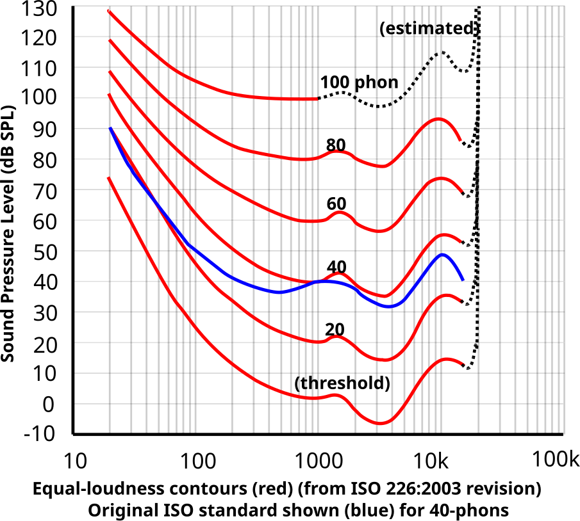
Figure 1 Equal-loudness contours
Hybrid and electric vehicles generate vibrations and noise that are different from those generated by internal combustion engines, and in a more unpleasant frequency range for humans. While internal combustion engines generate sound and vibration primarily in lower frequencies, with the majority between 20 and 600 hertz, electric and hybrid powertrains generate sound and vibration up to 10,000 hertz and more. [2]
Moreover, the popularity of EVs has also changed customer expectations. Buyers often associate electric mobility with smoothness, refinement and near-silent operation.
Consequently, occupants tend to be more sensitive to noises that might previously have gone unnoticed.
In addition, the human auditory system is particularly sensitive to tonal sounds, as their narrowband frequency components stand out clearly from broadband background noise. Consequently, tonal noises are generally perceived as more noticeable and annoying than broadband noises of similar sound pressure levels.
It’s for this reason that gear whine is one of the most objectionable driveline noise phenomenon, with even relatively low vibration levels that can produce a noticeable and irritating acoustic response inside the vehicle.
Consequently, minimizing gear whine and optimizing its perceived sound quality have become central objectives of modern gearbox NVH engineering.
Understanding the Origin of Gear Whine
Among the various NVH phenomena encountered in transmission development, gear whine noise (GWN) remains one of the most challenging and frequently investigated issues. The GWN is an acoustic problem, which can be quite fastidious if it is present within the car, because of the presence of values of frequency and acoustic levels of pressure relatively high. Many factors influence the vibro-acoustic emissions, mainly they are:
- Transmission error
- Variation of meshing stiffness
- Dynamical forces of meshing
- Friction forces [3]
The fundamental mechanism behind gear whine is transmission error (TE). Transmission error can be described as the deviation between the actual angular position of a driven gear and its ideal position during operation.
In an ideal gearbox, motion would be transmitted perfectly smoothly. In reality, however, various factors cause small deviations in rotational motion:
- Manufacturing tolerances
- Gear tooth profile deviations
- Elastic deformation under load
- Shaft bending
- Bearing compliance
- Misalignment effects
These deviations generate periodic fluctuations that act as excitation sources within the transmission system. This sends vibrational energy through the shafts and bearings to the gearbox housing, which radiates it outward as an audible, high-pitched whine. [4]
Order Analysis: a Simple Way to Detect Noisy Gears
Because the excitation is directly related to the rotational speed of the gears, gear whine is most effectively investigated using order analysis. Unlike conventional frequency analysis, which displays vibration as a function of frequency, order analysis expresses the vibration content as multiples (orders) of the shaft rotational speed. This approach allows gear-related excitations to be tracked accurately over varying operating speeds, separating them from other vibration sources and enabling the identification of gear mesh orders responsible for the perceived whine.
Gearboxes contain multiple rotating components, each generating vibrations and noise at characteristic frequencies. Since several gears, shafts, bearings, and the electric motor may operate simultaneously, the measured acoustic spectrum often contains numerous overlapping tonal components. Simply observing peaks in a frequency spectrum is therefore insufficient to determine the origin of a particular whine. Order analysis addresses this challenge by relating vibration and acoustic measurements to the rotational speed of the transmission components.
An order is a frequency normalized by the rotational speed of a reference shaft,
𝑂𝑟𝑑𝑒𝑟 = 𝑓 / 𝑛
where
- (𝑓) is the measured frequency (Hz),
- (𝑛) is the rotational speed (Hz).
Unlike a conventional FFT, where peaks shift as rotational speed changes, order analysis represents frequencies as multiples of shaft speed. Components associated with the same rotating element therefore remain at constant order values during speed sweeps.
Gear whine is generated primarily at the gear mesh frequency (GMF),
𝐺𝑀𝐹 = 𝑁𝑓𝑟
where
- (𝑁) is the number of teeth,
- (𝑓𝑟) is the rotational frequency of the gear.
The GMF therefore corresponds to an order equal to the number of teeth,
For example:
Gear A:
- 82 teeth
- rotating at 1500 rpm
then
𝑓𝑟 = 1500/60 = 25 𝐻𝑧
And
𝑓𝐺𝑀𝐹 = 82 ∗ 25 = 2050 𝐻𝑧
A 2050 Hz tonal component would therefore indicate excitation originating from this gear mesh.
A Practical Example: Whine Noise from STLA e-DCT
MHEV Transmission
Most Stellantis-brand hybrid vehicles in Europe are now equipped with an eDCT transmission
with an integrated 21-kW electric motor, achieving up to 20% reduction in CO2 emissions
compared to a combustion engine with an automatic transmission. Stellantis is currently
producing hybrid vehicles in more than 70% of its plants in Europe with a combined
production capacity of over 1.2 million eDCTs per year. [5]
This key product for the Stellantis hybridization strategy has been completely developed in
the Stellantis e-transmissions offices in Eindhoven and mostly in Sint-Truiden, where more
than 20 Engibex consultants are currently involved in this project.
The gearbox is derived from a previous concept intended for Asian market, which has been
modified and optimized adding an electric motor to improve performances and efficiency.
Simplifying the concept, it is made up of three clutches and three shafts, and utilizes a drum
technology for gearshifts. The electric motor is connected to the primary shaft throughout a
reducer, enabling the electric drive at low speed while the engine is decoupled from the
gearbox.
This concept is extremely efficient and compact, in such a way that it can fit in different
platforms and models, from the small Peugeot 208 up to the premium vehicles like the new
Lancia Gamma.
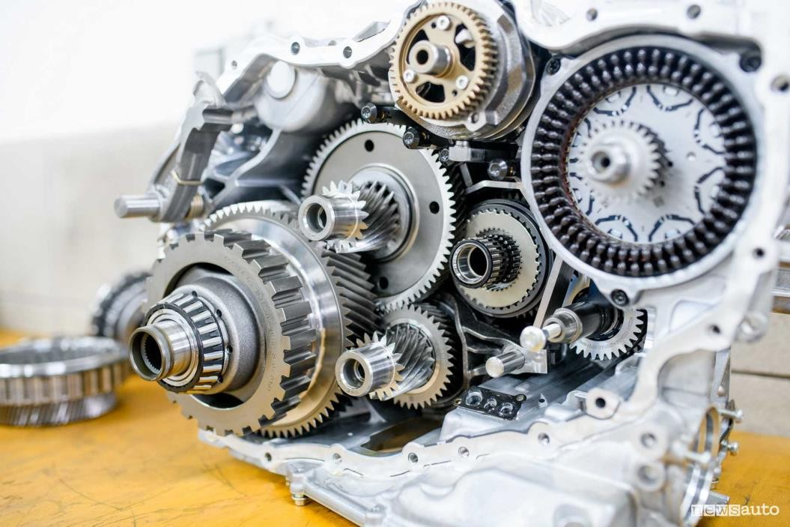
Figure 2 STLA e-DCT MHEV 6 speed transmission [6]
All these features do not make it immune from having differential whine noise problems, which is one of the most common driveline NVH issues encountered during vehicle development, production, and in-service operation.
In this section, we will go through a very simple and effective method used by NVH engineers to identify the source of a whine noise in a gearbox with a vehicle test.
The procedure is straightforward: drive the vehicle in the scenario for which the noise appears, while measuring accelerometers and microphones data.
An accelerometer placed on the transmission measures the vibration transmitted through the differential housing. Unlike microphones, which are influenced by surrounding acoustic noise, accelerometers directly capture the structural vibration generated by the gear mesh.
However, since the noise perception from the driver is fundamental for NVH engineers, one or more microphones are placed close to the driver’s head position.
The torque path flows from the engine (or the e-motor) and passes trough a series of gears (depending on the engaged gear) where the speed is reduced and torque is increased, until reaching the driveshafts and it’s transmitted to the driving wheels.
Every gear rotates at a different speed and it will have a different order compared to the input shaft. For sake of simplicity we will consider the input speed (speed of the engine) as the reference on which the orders are calculated.
The STLA-et MHEV gearbox has a final drive ratio of 0.251 in gear five, that means that the output speed will be 0.251 times the input, while the output torque is roughly multiplied by
four.
The differential crown has 67 teeth and is connected to the pinion of the upper secondary shaft which has 16 teeth.
These data are enough to calculate the order of the mesh between pinion and differential crown in gear five, with respect to the input speed:
𝑂𝑑𝑖𝑓𝑓 = 𝑁𝑑𝑖𝑓𝑓 ∗ 𝐹𝐷𝑟𝑎𝑡𝑖𝑜 = 67 ∗ 0.251 = 16.82
The testing procedure consists in driving the vehicle while measuring NVH data and acquiring signals from the CAN system, like engine speed and torque, that will be essential to understand the driving scenario and to calculate the orders.
Once the test is completed the NVH engineer could use different types of software to process the data with a Fast Fourier Transform (FFT), which will be able to convert the measured signals from the time domain to the frequency domain.
These software can easily interact with the CAN data and calculate the orders based on one speed given as a reference. In the case of our test, the orders based on the input speed (engine speed) have been calculated and plotted in a colormap picture, like in figure 3 below.
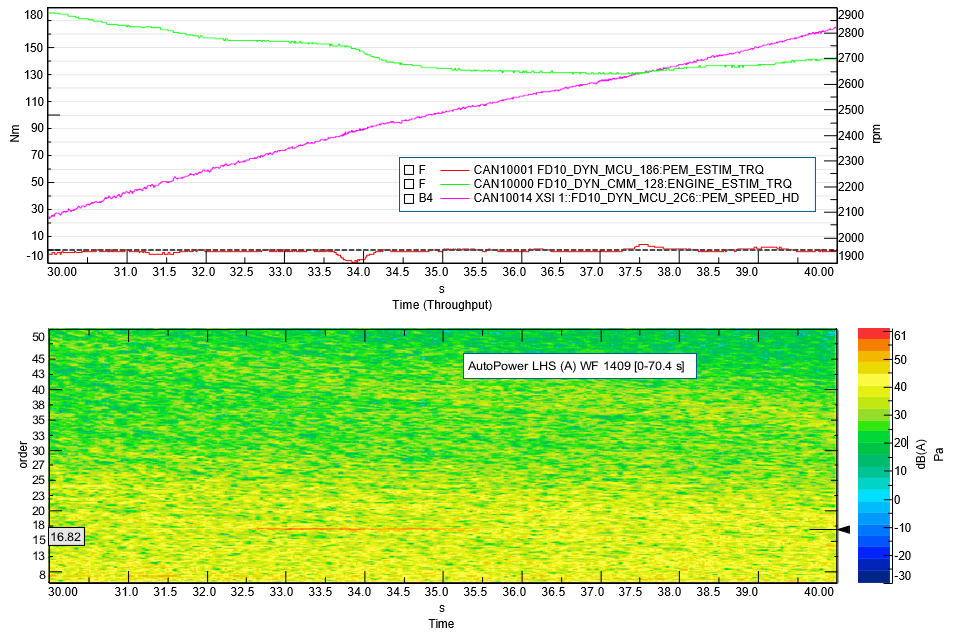
Figure 3 FFT analysis
A colormap is a 3D diagram, a very powerful tool used for identifying speed-dependent noise sources such as gear whine. It plots the vibration amplitude or sound pressure in a frequency (or order) domain, in function of different variables like for example time or vehicle speed.
Figure 3 shows the sound pressure in function of time, synchronized with the powertrain torque and engine speed. The red line between 32 and 36 seconds has to be interpreted as a high sound pressure level, that stands out among the other frequency. It corresponds exactly
to the order 16.82, which is the differential order for gear five.
This vehicle is clearly affected by a whine noise at the differential crown mesh, that could be result in an annoying effect for the driver, and will have to be assessed by the NVH engineers. Since the final drive crown is constantly in mesh with its pinion, it is not possible with this order analysis to clarify if the issue is coming from the crown gear or from the pinion. Indeed the order analysis is not able to identify the noisy gear, but only the gear mesh from which the whine is generated.
Engineering Strategies for Gearbox NVH Optimization
One of the most powerful tools available to gearbox engineers is gear microgeometry optimization.
Although gears may appear identical at a macroscopic level, small modifications to tooth geometry can significantly influence NVH behaviour. Profile corrections, lead modifications and crowning techniques are commonly used to improve load distribution and reduce transmission error. These adjustments compensate for elastic deformations and misalignment effects encountered under operating conditions. The objective is not necessarily to eliminate excitation entirely, but rather to minimize the dynamic forces generated during meshing.
Leveraging simulation tools can also be a game- hanger in optimizing gear design and performance concerning NVH requirements. Computer aided engineering tools allow for the modelling of gear systems to predict potential NVH issues before physical prototypes are built. These tools can simulate how changes in design, material, or manufacturing processes will affect noise and vibration levels. Once a prototype is developed, real-world testing should be conducted to validate the simulation results and make any necessary adjustments. [7]
A partial solution to gear whine could also be to reduce the excitation generated by the gears. The gearbox structure also plays an important role in determining how much vibration is transmitted and radiated as noise.
To reduce gear whine engineers could typically optimise:
- Housing stiffness
- Rib placement
- Bearing support design
- Mounting interfaces
These design changes help move the natural frequencies of the gearbox away from the main excitation orders, reducing resonance and lowering the resulting noise.
This is especially important in electric and hybrid vehicles, where gear mesh frequencies are higher and the absence of engine noise makes gear whine easier to hear.
Conclusion
Electrification has fundamentally transformed the NVH landscape of the automotive industry. As traditional masking sources disappear, gearbox-related noise becomes increasingly audible and increasingly influential on perceived vehicle quality.
Addressing this challenge requires more than reducing vibration levels or lowering sound pressure measurements. It demands a comprehensive understanding of transmission error, gear dynamics, structural behaviour and human perception.
The future of gearbox NVH engineering lies in bridging these domains. By combining advanced simulation, experimental validation and sound quality engineering, manufacturers can develop transmissions that not only meet technical requirements but also deliver the refined driving experience expected from modern electrified vehicles.
References
- Hede, A. J., & Bullen, R. B. (1981). Human Perception and Reaction to
Noise. Architectural Science Review, 24(3), 58–64.
https://doi.org/10.1080/00038628.1981.9696469 - How to meet brand and customer NVH expectations for electric and hybrid vehicles – VI
grade - Niola, Vincenzo & Avagliano, V. & Quaremba, Giuseppe. (2011). The gear whine noise.
445-450. - Determining the Source of Gear Whine Noise – Donald R. Houser, Ph.D. – February 1,
2004 - Stellantis Extends Benchmark Hybrid Powertrain to More Nameplates to Satisfy European
Customer Demand – July, 9 2024 – www.stellantis.com - Cambio eDCT Stellantis, caratteristiche, come funziona e vantaggi per le auto ibride –
Manuel Cerfreda – April 29, 2025 – newsauto.it - How to Ensure Your Gears Meet NVH (Noise, Vibration, Harshness) Requirements –
www.eureka.patsnap.com