
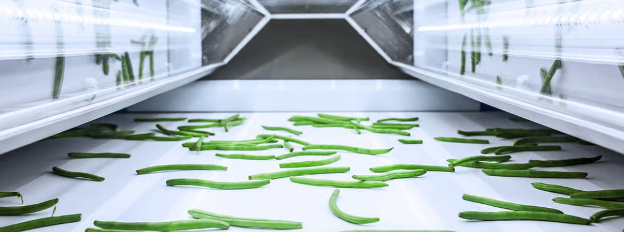
Intelligent Automation in Food Sorting: QA Engineering Behind a High-Capacity Food Sorting System
1. Introduction / Context
In 2025, the global food industry processes billions of tons of agricultural and processed products every year. Yet, industry studies consistently indicate that up to 10% of processed food is lost or downgradeddue to quality issues, contamination, or late stage defect detection. For food producers, even isolated foreign object incidents can trigger large scale recalls, regulatory scrutiny, and long term reputational damage.
At the same time, consumer expectations and regulatory requirements around food safety, traceability, and sustainability are rising sharply. Manufacturers are therefore under pressure to improve quality assurance without sacrificing throughput or efficiency. This has accelerated the adoption of intelligent automation, advanced sensor technologies, and data driven decision making in food production lines.Within this context, sensor-based sorting systems have become a cornerstone of modern food processing. High-capacity optical sorting machines are now capable of detecting defects and contaminants at industrial speeds. Behind this advanced hardware lies a complex software and automation stack, where QA engineering plays a critical role in ensuring reliability, accuracy, and consistency under real world conditions.
2. Key Technologies Driving Intelligent Sorting
2.1 Sensor Fusion: Seeing Beyond the Human Eye
Modern food sorting systems no longer rely on a single sensing modality. Modern food sorting systems no longer rely on a single sensing modality. The sorting system leverages sensor fusion, combining multiple complementary technologies to achieve a level of detection far beyond human visual inspection:
- High resolution optical cameras capture color, shape, and surface level defects.
- Laser based sensors detect surface irregularities, translucency differences, and internal structure variations.
- High speed data processing allows these inputs to be analyzed in real time at production line speeds.
By correlating data from multiple sensors, the system can reliably identify foreign objects, damaged products, or subtle defects that would otherwise go unnoticed. For QA engineers, this multi sensor approach introduces additional complexity: validating results now means ensuring consistent behavior across multiple sensing pipelines, each with different failure modes and tolerances.
Engineering implication: QA teams must validate not only individual sensors but also the correctness of the fusion logic that combines their outputs into a single sorting decision.

2.2 Automation Frameworks: From Requirements to Reliable Behavior
Testing an intelligent sorter is fundamentally different from testing a traditional software application. The system combines:
- Real time control software
- Embedded hardware interfaces
- Operator interaction via HMIs
- Sensor driven decision logic
QA engineering focuses on system-level validation rather than isolated component testing.
This approach enables:
- Clear, human readable acceptance criteria shared across QA and domain experts
- Early alignment between requirements and system behavior
- Repeatable regression testing of critical scenarios
By translating operational expectations into executable specifications, QA engineers ensure that sorting logic behaves correctly not only in nominal cases but also under edge and failure conditions.
2.3 CI/CD and Traceability
Automation is most effective when embedded directly into the development lifecycle. In modern engineering environments, this means: automated test execution, traceability, early detection of regressions.
This approach allows teams to innovate faster while keeping system quality stable. For engineering teams, the feedback loop is shortened dramatically: issues are detected in minutes rather than weeks.
Engineering implication: CI/CD transforms QA from a gatekeeper at the end of development into a continuous quality partner throughout the engineering process.
3. QA Challenges in Real World Food Sorting
Despite advanced tooling, real world validation remains challenging. Key QA obstacles include:
- Product variability: natural products vary in size, shape, color, and texture
- Rare defect scenarios: some contaminants occur infrequently but have severe consequences
- Hardware variability: small differences between machines can affect sensor readings
To address these challenges, QA teams employ a multi-layered strategy:
- Simulation based testing to generate rare or extreme scenarios
- Hardware in the Loop (HIL) testing for full system validation
- Automated regression suites to ensure stability over time
This combination ensures that software behavior remains robust even as hardware configurations and product profiles evolve.
4. Outlook: The Future of Intelligent Food Sorting
Looking ahead, food sorting systems are expected to evolve rapidly in several directions:
- AI and machine learning for adaptive, self learning classification
- Advanced analytics for traceability, yield optimization, and process insights
- Cloud connectivity enabling remote monitoring, diagnostics, and predictive maintenance
As these capabilities expand, QA engineering will become even more critical. Ensuring explainability, reliability, and regulatory compliance in AI driven systems will require new testing methodologies, stronger simulation environments, and deeper collaboration between software, hardware, and data teams.
5. Conclusion
Intelligent automation is reshaping food sorting, enabling manufacturers to meet increasing demands for safety, quality, and efficiency. At the heart of this transformation lies a close integration of advanced sensors, robust software, and rigorous QA engineering.
Through structured automation frameworks, CI/CD pipelines, and system level validation, QA ensures that innovations like modern industrial sorting machines deliver reliable, real world performance. In doing so, engineering teams help set new benchmarks for precision and trust in global food processing.
