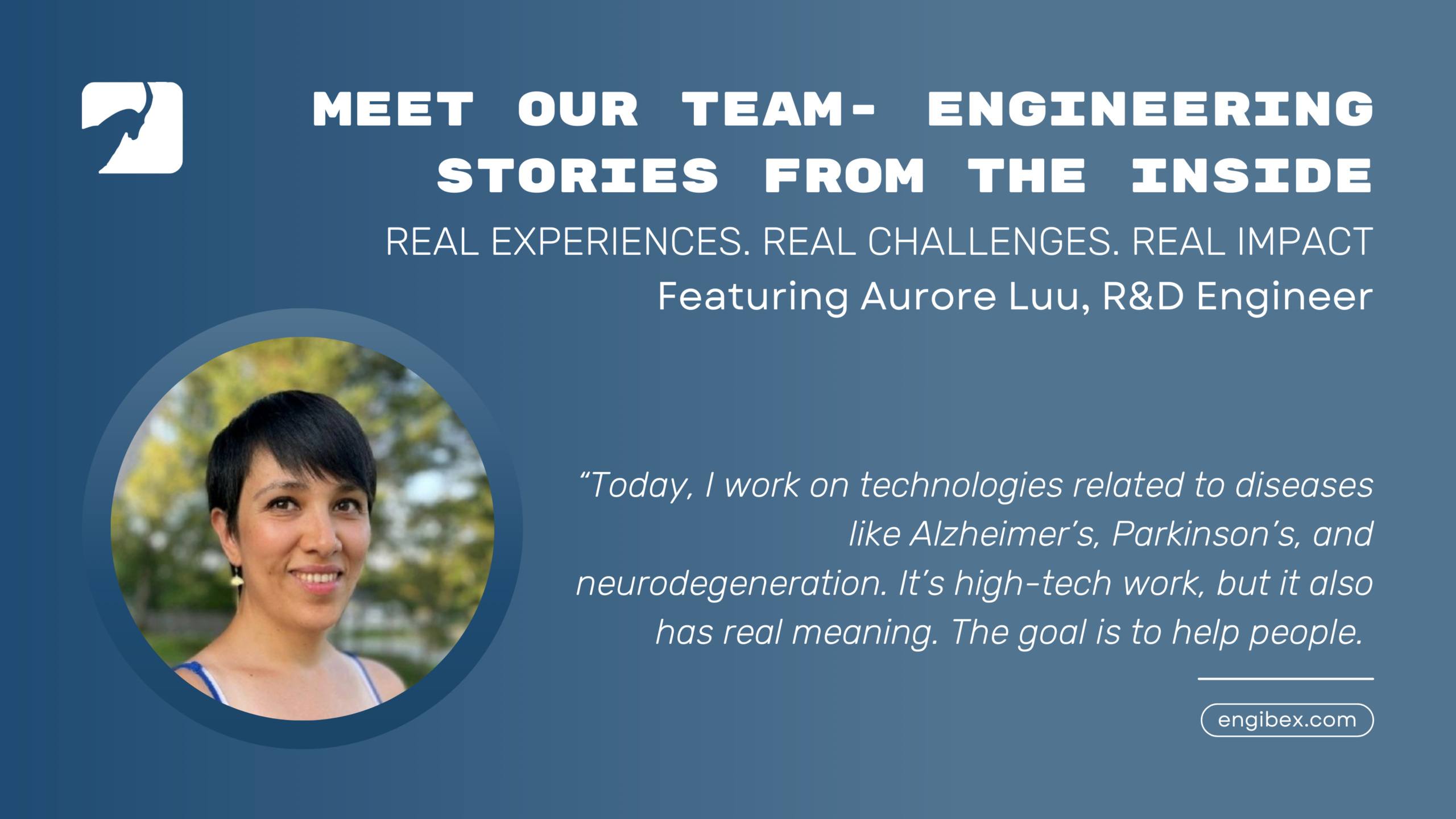
MEET OUR TEAM- ENGINEERING STORIES FROM THE INSIDE. FEATURING Aurore Luu, R&D Engineer
In this edition of “Meet Our Team”, we speak with Aurore Luu, R&D Engineer at Engibex. With a strong background in electronics and research-driven innovation, Aurore has built her career at the intersection of advanced technology and real-world impact. From working in highly specialized laboratory environments to contributing to cutting-edge developments in life sciences, she shares her journey, her passion for experimentation, and her perspective on growth, curiosity, and engineering as a woman in tech.
"Tell the reader a little about yourself"
I’m an engineer, a mother of two, and someone who is constantly learning how to balance different parts of life. My career is important to me, my family is everything to me, and I’m still discovering how to make space for myself in between.
The balance is never fixed. Sometimes your children need more of you. Sometimes work requires extra energy. And sometimes, you simply need to pause, go out, see friends, eat fries in front of the TV and just reconnect with yourself.
Over the past few years, I realised that as women, especially as mothers, we can sometimes forget ourselves. You can love your job and love your children deeply, but you shouldn’t forget who you are as a woman.
"Can you tell us about your journey into engineering?"
I truly believe engineering is for women. When I was younger, I didn’t even realise that there were fewer women in the field. I studied physics in engineering school, and I always felt that boys and girls were equal.
My parents never told me engineering was a “boy thing,” so I never questioned it. I was lucky. I was good at many subjects, so choosing wasn’t easy, but I was naturally drawn to science.
It was only later that I realised engineering is still largely a male-dominated world.
After my studies I did a PhD, which is funny because initially I didn’t want to. I wanted to start working right away. Then I received an offer in Paris. I didn’t want to move there at first- it felt too crowded and far from home. But I went for the interview and training, and I loved the people and the subject. It was a project for Airbus, and I thought, “It would be silly to refuse.”
That experience truly shaped my career.
"What first sparked your interest in this field?"
It really started during my PhD. It was a complete discovery for me, and I found it absolutely fascinating.
Electronics is constantly evolving. You always need to understand new phenomena, explore new techniques, and test new technologies. I worked with particle accelerators– there are only a few facilities opened to external users in the world, and Belgium has one of them.
I loved the experimental aspect of the job. Going to the machines, adjusting settings, testing conditions– the laboratory environment was incredibly stimulating for me.
"How has your career evolved since then?"
Three years ago, I transitioned from radiation engineering into electronic device tests at wafer level for very specific applications, mainly in life sciences.
Today, I work on technologies related to diseases like Alzheimer’s, Parkinson’s, and neurodegeneration. It’s high-tech work, but it also has real meaning. The goal is to help people. I’m involved in validating fabrication processes. Sometimes something works perfectly on paper, but not in real life and then we have to understand why. That investigative part still excites me. I keep learning by exchanging with colleagues, staying curious, and constantly adapting.
"What does a good working day look like for you?"
A good day is when I find a solution to a complex problem. Or when I help someone move forward.
We often welcome newcomers, and in a research environment, things are not always documented step by step like in aerospace, for example. There is more room for creativity but also more uncertainty. I really enjoy guiding new colleagues and explaining how things work. Sharing knowledge is something that gives me a lot of satisfaction.
"Engineering is still a field where women are underrepresented. How has your experience been?"
Personally, I was raised to believe I could do whatever I wanted. My parents always encouraged me to be strong and independent. My father told me not to rely financially or professionally on anyone– to rely on myself.
Now, I try to raise my children with openness and freedom. I have a son and a daughter. My son loves dresses, princesses and glitter. If you ask him to choose between a car toy and a Barbie, he might choose Barbie and that’s perfectly fine. I want my children to know that nothing is forbidden because of gender. Boys can cry. Girls can become engineers. Everyone should feel free to be themselves.
"When things get complex or stressful, how do you recharge?"
I talk. A lot. I send very long voice messages to my best friend in Brazil, and I speak often with my sister in Switzerland– she is one of the closest people to me.
I also go out for dinner with friends. And of course, I hug my children. They need hugs from me, but I’ve realised that I need hugs from them too. Sometimes my daughter Mila, who is four, senses when I’m tired and hugs me like a grown-up. I’m their mother, but sometimes they take care of me as well.
"Outside of engineering, what are you passionate about?"
I love manual and creative activities. I sew sweaters and pants, and I’m currently trying to finish a skirt for myself– it’s been a six-month project so far! Maybe I’ll finish it by summer.
I also take pottery classes and work with clay. I’d love to buy my own wheel one day. The wheel isn’t too expensive, but the oven is the real challenge! So for now, I continue taking classes.
When I was younger, I also enjoyed woodworking. From time to time, I go to a workshop, I even have one planned in March. One of my dreams is to build my own table.
"Finally, what advice would you give to young engineers?"
Just try.
When you hear about a big project, it can feel overwhelming, like it’s too big for you. But if you take it step by step, you’ll eventually realise, “Oh… I’m actually good at this.”
And don’t be afraid to change your path. Our parents’ generation often chose one direction and stayed on it for life. Today, we have more flexibility. Change isn’t something to fear, it can open new doors you never imagined.