
The Critical Role of System- and Subsystem-Level Simulation in Early-Stage Product Development
In today’s competitive engineering landscape, the ability to develop high-performance products efficiently and cost-effectively is critical to success. Since the 1990s, the typical vehicle development timeline has nearly halved, driven by advances in digital transformation, simulation technologies, and flexible manufacturing. These innovations enable automakers to respond more rapidly to evolving market demands and regulatory pressures while delivering increasingly sophisticated vehicles.
This rapid pace of technological evolution echoes Alvin Toffler’s foresight in Future Shock, where he predicted: “The illiterate of the 21st century will not be those who cannot read and write, but those who cannot learn, unlearn, and relearn.” In this context, success in modern engineering depends not only on technical expertise but also on the agility to adapt and innovate continuously.
System and subsystem-level simulation during early-stage product development has emerged as one of the most powerful methodologies for achieving faster development timelines. As engineering systems become increasingly complex and interconnected, the traditional "build-and-test" approach is proving inadequate — or at the very least, inefficient — for managing the intricate relationships between subsystems.
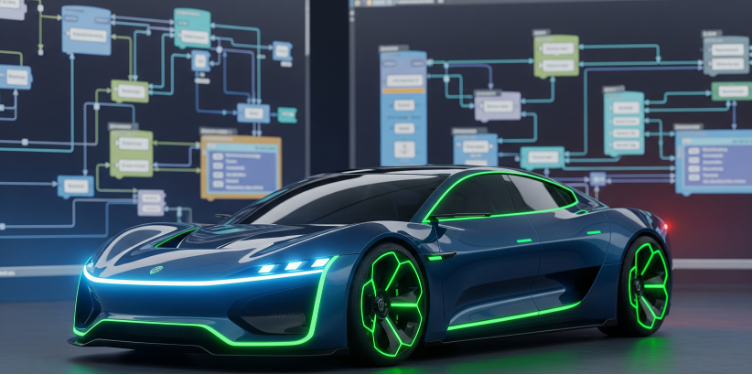
System-level simulation addresses this challenge by allowing engineers to explore the holistic behavior of complex physical systems. These models link computational elements with physical entities across multiple domains, including mechanical, electrical, thermal, and fluid systems.
A striking example comes from Tesla’s development of the 2008 Roadster. The company relied on system-level simulation and model-based design using MATLAB and Simulink to create and validate detailed subsystem models of the motor, battery, transmission, control systems, aerodynamics, and thermal behavior. This full-vehicle simulation enabled rapid performance evaluation and optimization long before hardware prototypes were built. By taking a virtual-first approach, Tesla could explore hundreds of design configurations in software, dramatically reducing costs and development time. This strategy allowed a lean startup to deliver a world-class electric sports car on a fraction of traditional automotive budgets.

Transformative Benefits of Early-Stage Simulation
Integrating system-level simulation during early product development phases provides transformative benefits that extend throughout the entire product lifecycle. Research shows that the majority of critical design decisions are made during early development stages — and errors at this stage often lead to costly revisions later.
Early-stage simulation reduces development costs by minimizing reliance on physical prototypes. Traditional prototyping methods demand significant investments in materials and labor, whereas virtual prototypes can be modified and tested repeatedly at a fraction of the cost. Studies show that companies implementing simulation-driven design experience an average 11% decrease in physical prototypes, directly lowering development expenses [2].
Challenges and Considerations in Early-Stage System Simulation
Despite its benefits, implementing system-level simulation early in the development cycle brings challenges that engineers must address:
- Uncertainty Management
Early-stage design involves high levels of uncertainty regarding system parameters, component specifications, and requirements. These uncertainties can make simulation results unreliable unless properly quantified. Robust uncertainty management is essential to ensure credible models that support design decisions. - Model Validation and Verification
Early-stage models often lack validation data since physical systems may not yet exist. This creates difficulty in establishing model credibility and determining the right level of fidelity. Engineers must balance model complexity with available validation data and computational resources. - Computational Complexity: Balancing Accuracy and Cost
System-level models can be computationally intensive, especially when capturing interactions between multiple subsystems. For instance, fluid flow analysis can be modeled using either direct numerical simulation (DNS) — highly accurate but resource-intensive — or empirical correlations, which are more efficient but less precise. Engineers must carefully balance accuracy with computational feasibility.

The Ather Energy article on Cell Models & Characterisation [3] illustrates this trade-off well. It compares different lithium-ion battery models, noting that adding RC branches to equivalent circuit models improves accuracy in capturing dynamic behavior. However, higher-order models demand complex parameter identification and more computational power, making them impractical for real-time applications. The lesson is clear: model fidelity must be carefully balanced against implementation cost and complexity.
Conclusion
The evidence underscores a fundamental conclusion: early-stage system and subsystem-level simulation is one of the most powerful methodologies available for modern product development. Companies that fail to embrace this approach risk falling behind competitors who leverage simulation to develop better products faster, cheaper, and with higher reliability. The question is no longer whether to adopt system-level simulation, but how quickly and comprehensively it can be integrated into existing development processes.
At the same time, engineers must not forget the importance of grounding simulations in first principles. Relying solely on software without a deep understanding of physics can lead to misinterpretations, flawed assumptions, and costly design errors. Core principles — such as conservation laws, material behavior, and system dynamics — remain the foundation of credible and innovative engineering.
As one seasoned engineer remarked: “The best thing about computer simulations is that they do exactly what you want — and that’s also the worst thing.” This is why strong engineering judgment, rooted in fundamentals, must guide every simulation effort.
Ultimately, system-level simulation is not a crutch but a powerful extension of sound engineering judgment — and when applied effectively, it can redefine what’s possible in product development.
References:
- Gadda, C., & Simpson, A. (2009). Using model-based design to build the Tesla Roadster. MathWorks. https://in.mathworks.com/company/technical-articles/using-model-based-design-to-build-the-tesla-roadster.html
- Ansys. (n.d.). Quantifying the impact: The business value of engineering simulation [eBook]. https://s3.amazonaws.com/bizzabo.users.files/139477/296909/6968783/Quantifying%20the%20Impact_Ansys_ebook.PDF
- Ather Energy. (2022, September 29). Cell models & characterisation. Ather Energy Blog. https://blog.atherenergy.com/cell-models-characterisation-a1bce42b87f9
