

Thermal Energy Storage: A bridge to Renewable Reliability
Climate changes and typical problem with renewable energy production
The depletion of natural energy sources and its relation to environmental pollution is a significant problem for humankind. Climate change is becoming increasingly evident. For this reason, a complete shift to renewable energy production is urgently required. The European energy sector is undergoing a transition generating more and more energy from renewable sources rather than coal or gas. Furthermore, the European Commission introduced a roadmap up to 2050, aiming to reduce CO₂ emissions by 95% compared to 1990 levels. To support this goal, the COP21 (Paris) established additional targets for the maximum allowable increase in global temperature. [1]
However, it often happens that energy consumption does not match with production from renewable sources. For example, photovoltaic (PV) systems generate the most energy around midday, while user peak consumption typically occurs in the early morning or evening. In the case of wind energy, production is even more unpredictable, as it depends entirely on whether the wind is blowing or not. This intermittent nature of renewable energy can problems for the electrical grid, which requires a constant balance between supply and demand. For this reason, energy storage is crucial. There are several methods of storing energy: chemical, electrical, electrochemical, mechanical, and thermal. Thus, devices based on different working principle are needed.
The following article will focus of thermal energy storage (TES). This choice is justified by the fact that energy demand for space heating and cooling, along with water heating, accounts for 79.2% of household energy consumption, according to Eurostat, as illustrated in Figure 1.

TES has also another interesting application: power generation. The extra energy produced can be stored for a later use, for instance in the evening, to generate steam to drive a turbine and produce electricity. However, this goes behind the scope of this article, and it will not be further explained.
Thermal energy storage: operating principles and application
TES systems accumulate thermal energy by heating or cooling a storage medium, allowing the stored energy to be used later, even when renewable sources are not producing energy. In this way, TES helps in closing the mismatch between energy consumption and renewable energy production. This capability is essential for balancing supply and demand, particularly during periods of low renewable generation. TES contributes to a more flexible and resilient energy grid by decoupling energy production from consumption. [3] [4] [5]
A non-exhaustive list of TES application is depicted in figure 2.

One key aspect of TES is its storage density, which refers to the amount of energy that can be stored per unit of volume or mass. This property plays a crucial role in various areas, such as optimizing the solar ratio (the portion of solar radiation effectively used for heating or cooling), enhancing the performance of systems like solar thermal collectors and absorption chillers, and improving energy efficiency in space heating/cooling. In this context, phase-change materials (PCMs) may offer significant advantages. These will be later discussed in the article. [3] [4]
TES are usually applied on hot or cold side of an energy system. On the hot side, it enables the storage of heated water from solar collectors or auxiliary heaters, which can then be used either by the absorption chiller's generator in cooling mode or directly supplied to end users in heating mode. On the cold side, it allows the storage of chilled water produced by the absorption chiller, which is later distributed to indoor cooling units. Depending on the operating temperature, TES systems are commonly classified into hot, warm, and coldstorage. Typically, hot storage tanks operate around 80-90°C, warm tanks around 40-50°C, and cold tanks between 7-15°C. While hot thermal storage is standard in most solar systems, especially for space heating and domestic hot water (DHW), cold storage is more typical in large-scale installations. Cold storage provides not only economic benefits by allowing cooling during off-peak electricity hours (in systems using electric chillers) but also helps reduce peak cooling demand and enables more stable operation of the chiller. [3] [4]
Finally, energy storage systems can be evaluated based on several parameters: capacity, power, efficiency, storage period, charge/discharge time, and cost. A detailed analysis of all these characteristics falls outside the scope of this article. Instead, the focus will be on the storage medium and its working principle. [3]
TES types
Several TES technologies are commercially available, each with its own advantages and limitations. The TES family can be divided into thermal and chemical categories, with the first further divided into sensible heat storage and latent heat storage (which uses also PCM). An overview of the main TES technologies is illustrated in Figure 3, while an oversimplified schematic of some working methods in Figure 4. [3]


Thermal:
Sensible heat storage:
Sensible Heat Storage (SHS) is the most straightforward method of thermal energy storage (its working principle is shown in Figure 4(a)). It involves storing energy by heating or cooling a solid or liquid medium, such as water, sand, molten salts, or rocks, with water being the most cost-effective and widely used option. Indeed, nowadays, water remains the most common and commercially available storage medium, suitable for both residential and industrial applications. For larger-scale systems, underground storage of sensible heat in either liquid or solid form is also employed. [3] [4]
SHS offers two main benefits: it is inexpensive and avoids the hazards associated with toxic materials. Moreover, various system configurations exist for SHS, including water tank storage, Underground Thermal Energy Storage (UTES), and packed-bed (or pebble-bed) storage units. UTES typically uses natural ground materials like soil, sand, rocks, or clay to store heat or cold, while pebble-bed storage relies on the thermal capacity of loosely packed solid materials. However, a detailed explanation of these systems goes beyond the scope of this article and will not be further discussed. [3] [4]
Latent-Heat or Phase-Change Storage:
LHS (Latent Heat Storage) materials are often referred to as Phase Change Materials (PCM) because they absorb or release energy with a change in physical state as depicted in Figure 2 (b). Heat is primarily stored during the phase change process, typically at a nearly constant temperature, and this process is directly linked to the latent heat of the material. Using an LHS system with PCM provides an efficient method for thermal energy storage, offering the benefits of high energy storage density and the isothermal nature of the storage process. [3] [4]
The main advantage of using LHS over SHS is its ability to store heat within a nearly constant temperature range. Initially, these materials behave like SHS materials, with temperature rising linearly. However, as the phase change occurs, heat is either absorbed or released at a constant temperature while the material undergoes a change in physical state. [3] [4]
LHS materials are generally categorized based on their physical transformations, which determine their ability to absorb and release heat. One classification of PCM is into organic, inorganic, and eutecticmaterials as depicted in Figure 5. [3] [4]

To be thorough, the PMC can be characterized also based on the melting point as shown in Figure 6. However, this goes behind the scope of this article, and it will not be further explained.

Finally, molten salt storage is one of the most mature TES technologies, primarily used in Concentrated Solar Power (CSP) plants. This technology involves storing thermal energy in molten salts, such as sodium nitrate and potassium nitrate, which have high thermal stability and heat capacity. The salts are heated to high temperatures and stored in insulated tanks. The stored heat is then converted into electricity when needed.
Chemical:
TCS may also rely on thermochemical materials (TCM), which store and release heat through a reversible chemical reaction involving endothermic and exothermic processes, as illustrated in Figure 4 (c). During the charging phase, heat is applied to material A, causing it to break apart into two products, B and C. These can be easily separated and stored until they are needed for discharge. During the discharge phase, these are recombined under specific temperature and pressure conditions, releasing energy in the process.
Overview and comparison:
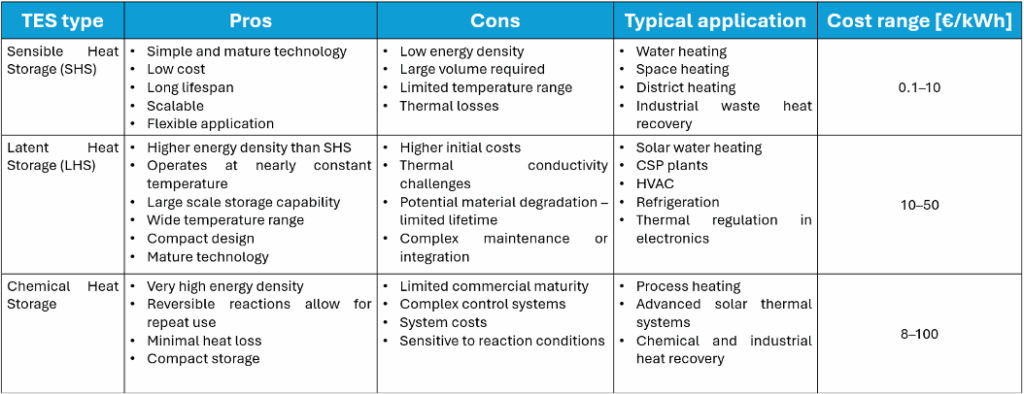
Each TES technologies have its pro and cons. Table 1 provide a comprehensive overview of their respective strengths and limitation for SHS, LHS and Chemical.
The step further:
TES can also be implemented on a larger scale, referred to as Seasonal Thermal Energy Storage (STES). In such system the thermal energy is stored in summer to be later used in winter. Following the same thinking as illustrated in Figure 3, STES technologies are generally divided into three main types: sensible heat storage(SHS), latent heat storage (LHS), and thermochemical heat storage (THS). Among STES technologies, sensible heat storage options like TTES and PTES are mature and efficient but limited by space needs and leakage risks. Borehole (BTES) and aquifer (ATES) systems provide large-scale storage and can be used for both heating and cooling but face geological constraints. LHS and THS systems offer higher energy density; however, they are typically more expensive, and face issues related to the stability and safety of storage materials. A detailed discussion of the advantages and limitations of each type, as well as an economical point of view is beyond the scope of this article and will not be treated.

Conclusion:
As the world moves toward a more sustainable and decarbonized energy future, overcoming the intermittent nature of renewable energy sources is crucial. Thermal energy storage is a technology that can help in this, facilitating a smooth transition and integration of renewable energy production into the grid. It helps providing one possible solution to one of renewable energy’s biggest challenges: the mismatch between supply and demand, particularly in systems like solar power and cogeneration. TES not only enhances the flexibility and reliability of energy systems but also supports greater integration of solar and wind power into the grid. Moreover, TES can also enhance energy security and power production in critical applications, including hospitals, data centers, and telecommunications infrastructure, while offering benefits such as thermal buffering. Technologies like molten salts, sensible heat, phase change materials, and thermochemical energy storage offer different advantages and limitations depending on the application. Choosing the right TES system solution helps build more reliable, resilient, and sustainable energy systems. Furthermore, large-scale applications such as seasonal thermal energy storage expand the potential of TES beyond daily cycles, addressing long-term energy balancing needs. Although challenges remain in terms of cost, scalability, and material stability, ongoing research and innovation continue to enhance the performance and economic feasibility of TES. As the technology continues to evolve, it is clear that TES will play an increasingly important role in the global transition to clean energy.
References:
- [1] F. C. P. L. Rev, “Unfccc, 2015,” vol. 21932, no. December, pp. 1–32, 2015.
- [2] e. S. Explained, “Energy consumption in households,” 2018. [Online]. Available: https://ec.europa.eu/eurostat/statistics-explained/index.php/Energy_consumption_in_households#Energy_consumption_in_households_by_type_of_end-use.
- [3] Sarbu, Ioan, and Calin Sebarchievici. "A comprehensive review of thermal energy storage." Sustainability 10.1 (2018): 191.
- [4] Chavan, S., Rudrapati, R., & Manickam, S. (2022). A comprehensive review on current advances of thermal energy storage and its applications. Alexandria Engineering Journal, 61(7), 5455-5463.
- [5] Yang, Tianrun, et al. "Seasonal thermal energy storage: A techno-economic literature review." Renewable and Sustainable Energy Reviews 139 (2021): 1-22.
- [6] Z. Yan, M. Yang, Y. Zhang, & Y. Li. (2020). "Review on molten salt storage for solar thermal power plants." Renewable and Sustainable Energy Reviews, 121, 109688.
- [7] M. Klein, A. Polag, & S. Leithoff. (2019). "Phase change materials in thermal energy storage: A comprehensive review of materials, applications, and potential." Journal of Energy Storage, 24, 100754.
- [8] B. E. R. (2019). "Thermochemical storage: An emerging technology for renewable energy applications." Energy Reports, 5, 249–259.
- [9] S. M. Yoon, K. B. Lee, & S. T. Kim. (2021). "Sensible heat storage systems: Technologies and applications." Energy, 118, 379-396.
